Let's make sense of those first meals without complicated feeding schedules or unnecessary worries.
Picture this: you've spent days choosing a tiny spoon, bought an adorable bowl and carefully prepared your baby's first vegetable purée.
Your baby looks at the spoon with curiosity, opens their mouth, takes a taste… and immediately spits everything back out.
And there you are, wondering: “Is it too early? Did I make something wrong?”
The truth is that starting solids rarely looks like those picture-perfect videos online.
And that's completely normal.
How do you know when your baby is ready for solid foods?
Most international guidelines recommend introducing solid foods at around six months.
Recommendations in Germany allow a slightly broader window, from the beginning of the fifth to the beginning of the seventh month, depending on the baby's development.
But age isn't the only thing that matters.
Look for several signs of readiness appearing together: your baby can hold their head steady, sit with support, coordinate their hands and mouth to bring food towards themselves, and swallow food rather than consistently pushing it back out with their tongue.
Simply staring at your dinner doesn't prove they're ready.
Neither does waking more often at night. Starting solids isn't a reliable way to make a baby sleep through the night.
If your baby was born prematurely, discuss the right timing with a healthcare professional.
If night waking is also a challenge, you might find our guide to why babies only sleep when held helpful.
What should you offer first: vegetables, porridge or something else?
You may have heard that babies must begin with one particular vegetable.
Fortunately, there's no universal first-food rule.
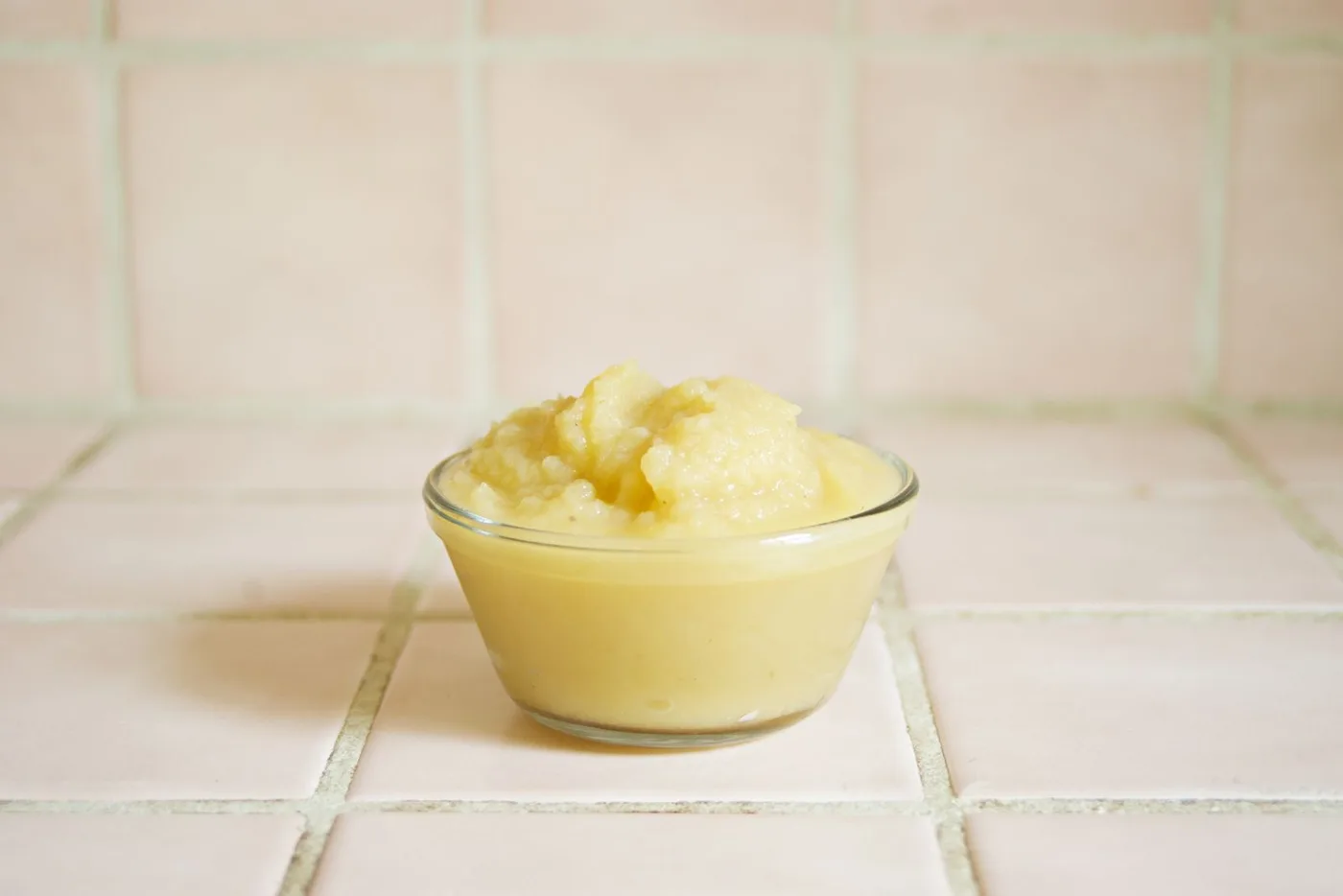
Depending on your baby's readiness, suitable options might include smooth vegetable purée, unsweetened infant porridge or other appropriately prepared foods.
You could try a little cooked broccoli, mashed potato or soft avocado.
The important thing is to gradually introduce a variety of foods.
Iron-rich foods deserve particular attention as babies grow. These include meat, beans, lentils and iron-fortified infant cereals.
During the second half of the first year, babies increasingly need iron from foods alongside their usual milk feeds.
And there's no need to replace an entire milk feed with a large bowl of purée on day one.
A few small spoonfuls are enough to begin exploring new tastes.
Breast milk or infant formula will remain an essential part of your baby's diet as solid foods are introduced.
Over time, the portions and variety of foods can gradually increase.
Purées or finger foods: which is better?
You've probably seen videos of six-month-old babies happily exploring broccoli, banana or pieces of soft vegetables.
This approach is often called baby-led weaning.
Instead of relying entirely on spoon-feeding, babies are offered suitable foods they can pick up themselves.
But traditional spoon-feeding is also a perfectly reasonable approach.
You don't necessarily have to choose one method.
Many families combine smooth purées with safely prepared soft finger foods.
What matters most is your baby's developmental ability.
One baby might be happiest starting with smooth textures. Another may be ready to explore mashed foods and soft pieces.
Avoid copying feeding videos without considering your own child's skills.
The texture and shape of food must suit their ability to sit upright, handle food and manage it safely in their mouth.
Why does your baby keep spitting food out?
Imagine being offered a completely unfamiliar food with a texture you've never experienced before.
You might not swallow it immediately either.
For babies, starting solids introduces a whole new world of flavours, smells, textures and tongue movements.
Sometimes food comes straight back out simply because your baby is still learning how to move it around their mouth and swallow.
Sometimes they dislike the taste.
And sometimes they just aren't hungry.
Don't pressure your baby to finish a portion or distract them with cartoons to sneak in another spoonful.
It's usually better to end the meal calmly and offer the food again another day.
Some babies need many opportunities to explore an unfamiliar food before they begin accepting it.
Which foods should babies avoid?
A few safety rules are especially important.
Never give honey to a baby younger than 12 months because of the risk of infant botulism.
Avoid adding salt or sugar to baby food.
Whole nuts, whole grapes and hard pieces of raw carrot or apple can cause choking.
Food should always be prepared in a form appropriate for your baby's eating skills.
Your baby should sit upright during meals, with an adult supervising continuously.
What about common allergens?
Foods such as eggs, fish, wheat and peanuts generally don't need to be postponed for years.
Once your baby is ready for solid foods, potentially allergenic foods can be introduced in age-appropriate forms and small amounts, one at a time, so you can watch for reactions.
For example, a little smooth peanut butter can be thoroughly mixed into purée to make it thinner.
Never offer whole peanuts or a spoonful of thick peanut butter.
If your baby has severe eczema or a known food allergy, ask a healthcare professional how to introduce potential allergens safely.
What if your baby just isn't interested?
Try not to compare your baby with children on social media.
One baby eagerly explores every new flavour.
Another spends several days inspecting the spoon, spreading purée across the table and swallowing almost nothing.
Early on, that can be a perfectly ordinary part of learning.
However, speak to your baby's healthcare professional if they repeatedly choke, struggle to swallow, refuse both solid foods and milk feeds, or aren't gaining enough weight.
And remember: starting solids isn't a competition to see whose baby eats the most.
Your child is learning an entirely new skill.
Your job is to make that experience calm, safe and free from pressure.
Sources & further reading
General information only; not medical, legal or financial advice.